It asks what a good tobacconist would ask. Then it only shows you what's on the shelf.
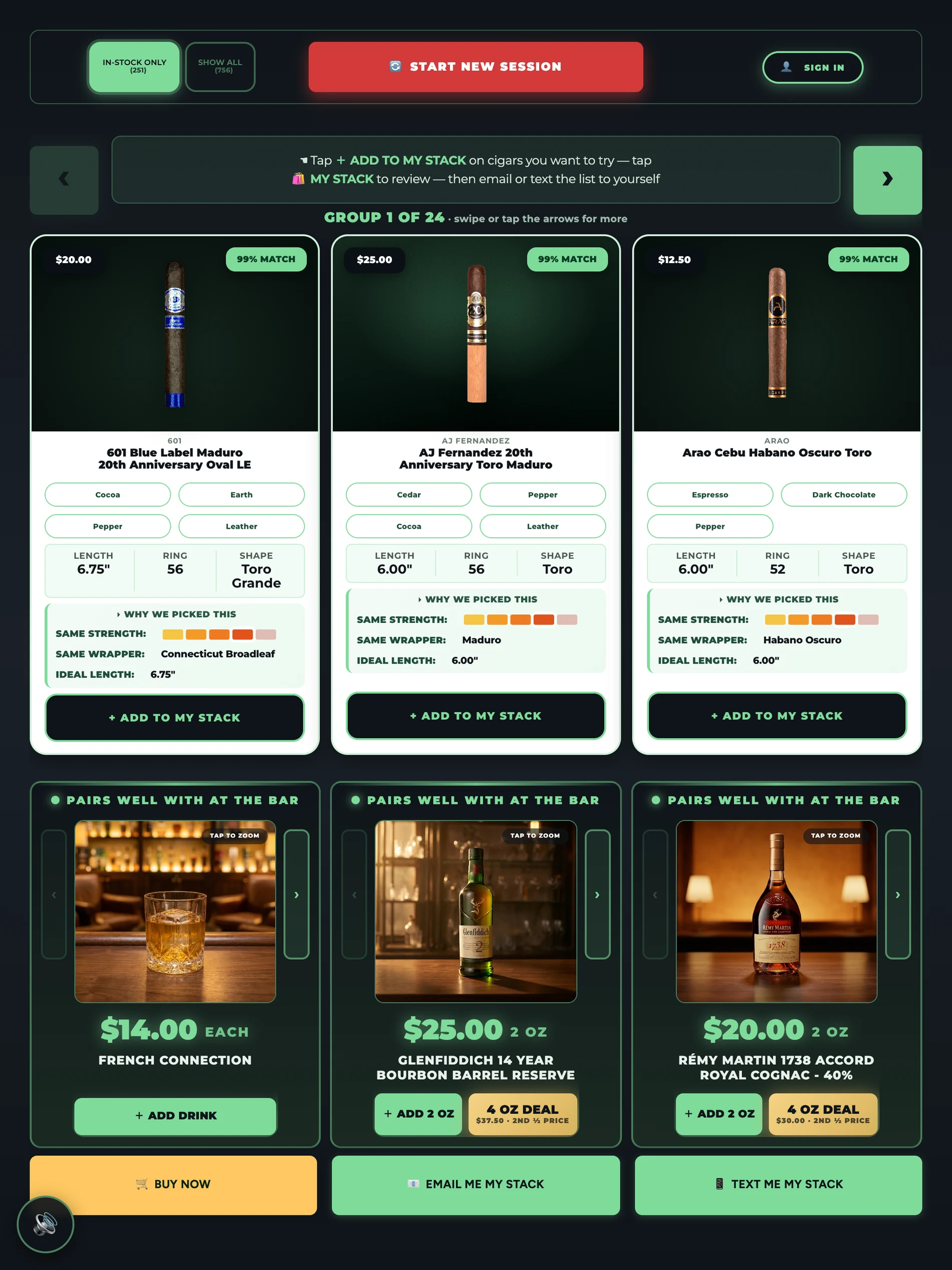
A guest names a cigar they already like, or answers seven quick questions. Stack Finder scores your catalogue against that, leads with what's on the shelf right now, and explains why each one made the list.
Two ways in
Name a cigar you've enjoyed, or tap through six questions. No long form, and no cigar vocabulary required to start.
Your inventory first
It scores against live POS stock and leads with what you can hand over right now. A guest can still browse the rest — and ask to be told when something out of stock returns.
Reasons, not a black box
Every match says why it matched. Guests trust a recommendation they can see the logic behind.
Two ways in
Some guests know exactly what they like and want something near it. They name a cigar they've had before and Stack Finder finds the closest things you carry.
Others have no idea and don't want to admit it. Seven taps — how long they've enjoyed cigars, strength, flavored or traditional, shape, length, ring gauge, wrapper — and they get your humidor ranked against their answers, best first, instead of a wall of two hundred boxes.
Both paths end in the same place: your whole in-stock humidor, scored and ranked, best matches first, with a reason attached to each — and a way to keep going if none of them land.
What it weighs
The structural layer is what you'd expect: wrapper, strength, body, length, ring gauge, shape, origin, binder, filler, price band, and the line a cigar belongs to. Roughly a dozen attributes, and every serious tool in this category matches on something similar.
The difference is the flavor layer sitting on top of it. Stack Finder carries a controlled tasting vocabulary of 91 defined notes — not tags typed in freehand, but a mapped vocabulary where cocoa, dark chocolate, milk chocolate and mocha are distinct terms that know how they relate to each other.
That's why it can tell the difference between a guest who wants sweet and a guest who wants sweet-and-nutty, and why two cigars that look identical on a spec sheet don't come back with the same score.
The specific weights behind the scoring are not published — that's the part of Stack Finder worth protecting.
Why a dozen characteristics isn't enough
Match on structure alone and you get cigars that are the same size, same wrapper, same strength — and taste nothing like each other. Every experienced smoker has been handed that recommendation and quietly written the whole system off.
Wrapper matching is family-aware for the same reason. A Connecticut Broadleaf and a San Andrés maduro are both maduro, but they don't taste alike, so they score as similar rather than identical.
Structure narrows the field. Flavor is what makes the answer right. A system that only does the first half is a filter, not a tobacconist.
91 defined tasting notes, mapped to each other — plus the dozen structural attributes, not instead of them.
The questions this always raises.
What happens if nothing matches well?
It says so, and widens the search rather than padding the list with bad matches. A kiosk that recommends something wrong once stops getting used.
Does it push whatever I'm overstocked on?
Not at the cost of the match. Slow stock surfaces because guests are finally being told what's in the box, not because the engine was told to dump it.
How current is the stock data?
It reads live from your POS. Not a monthly catalog file — continuously.
It works with the rest of it.
See it on your own inventory.
Fifteen minutes, your cigars in the kiosk, and an honest answer about whether it fits your shop.